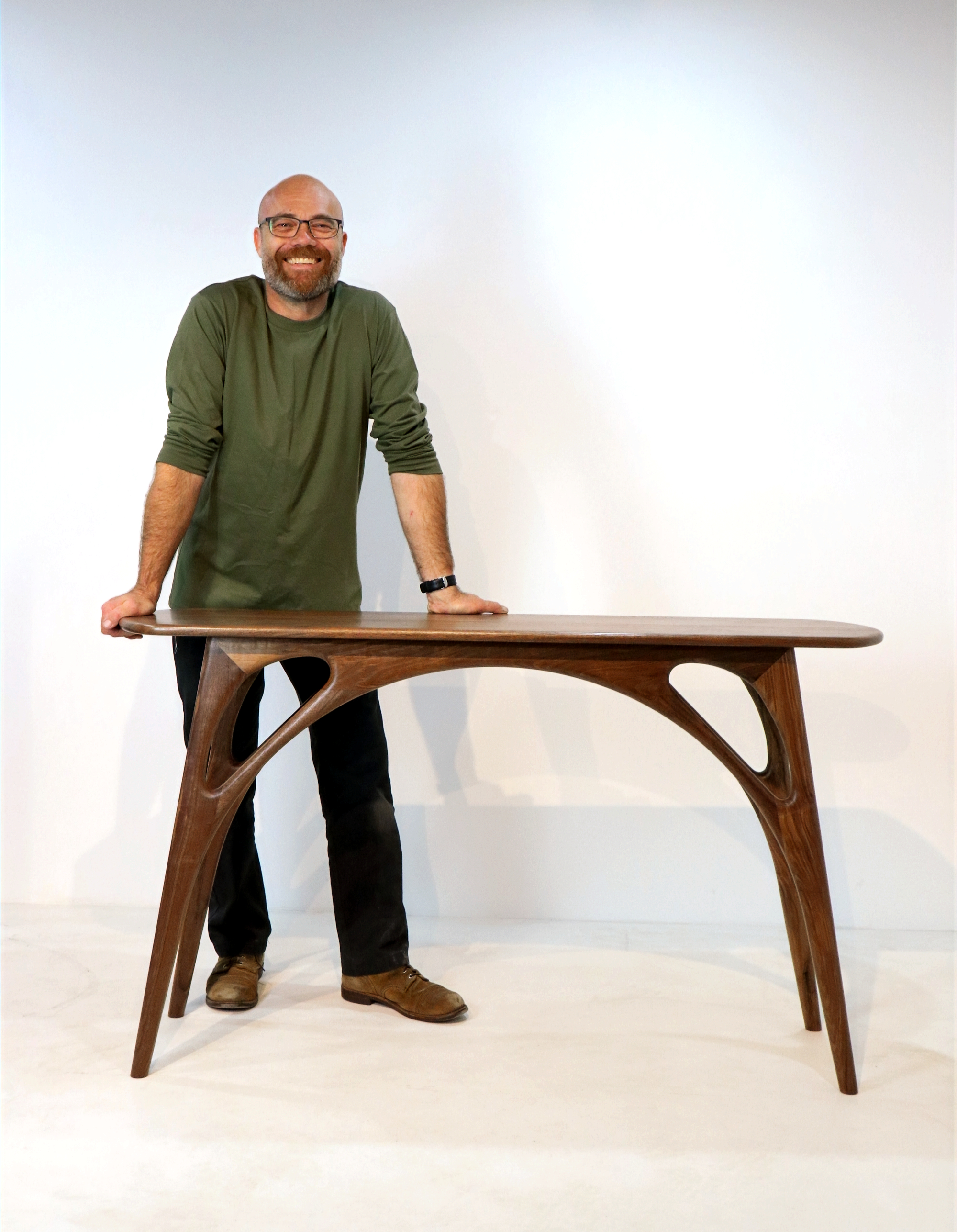
Furniture designer and maker.
I’m Brendan Cody, a furniture designer and maker based in Sydney. I came to furniture through art school and later Sturt School for Wood. Those years gave me a way of thinking that still sits at the centre of my practice: design and making are not separate things. A line on paper has to become a joint, a surface, a weight, a thing that someone will touch and live with. I have always loved that conversation between an idea and the stubborn, beautiful reality of timber.
For more than 15 years I have been part of Splinter Workshop, Sydney’s cooperative of independent designer-makers. Working around other makers for that long has shaped me enormously. It keeps you curious and humble. There is always another way to solve a joint, another opinion on proportion, another piece of timber worth stopping to look at. Splinter has also given me a working community built around quality, shared knowledge and the preservation of the craft.
I’m also the principal and co-founder of Chisel & Dowel Woodworking School. Teaching has become an important part of my life. Explaining why something works — grain direction, a joint, a curve, a sequence of operations — forces you to understand your own decisions more clearly. I love seeing people go from being nervous around tools to making something they are genuinely proud of. It reminds me why making matters.
Before and alongside furniture, I spent many years in customer-facing roles across entertainment and the service industry. I used to think of that as separate from furniture; now I see it as one of the most useful parts of my background. Commissioned work begins with listening. People do not always arrive with a fully resolved brief, but they often know how they want a room to feel, what frustrates them about what they have, or what they hope a piece will become over time. I enjoy getting underneath that and understanding what someone is truly looking for, then bringing the practical knowledge of joinery, wood and design to it.
Materials matter deeply to me. I prefer solid timber whenever it is the right solution. I love its weight, variation, repairability and the way it changes with age. I use the finest material I can source and I am careful about grain, colour, movement and the way individual boards relate to one another. But I am not dogmatic about solid wood. Veneer, stable panel materials, laminations and other methods can be the better choice when the design, scale or movement of timber requires them. Good veneering is an old and serious furniture-making technique, not a shortcut, and sometimes it opens up forms and surfaces that solid timber cannot sensibly achieve.
The same is true of technique. I use traditional joinery where it earns its place and modern machinery, jigs, digital processes or contemporary adhesives where they make the work more accurate, stronger or simply possible. The point is not to prove how something was made; it is to make it well. My finishes are almost exclusively hardwax oil unless the use of the piece asks for something else. I like a finish that protects the timber without hiding it, leaves the surface tactile, and can be maintained and repaired as the piece is lived with.
What I am trying to make is furniture that feels considered but not precious — pieces with presence, but without noise. I want them to work hard, feel good in the hand, and sit naturally in a space. The best commissions are collaborative. They end with something that feels unmistakably made for that particular person and place, and hopefully something they will keep for a very long time.
Have a piece in mind?
Tell Brendan what you’re looking for, the room it’s for, approximate dimensions and timing. A sketch or reference image is useful, but not essential.